

War/Garden by Graham Fagen
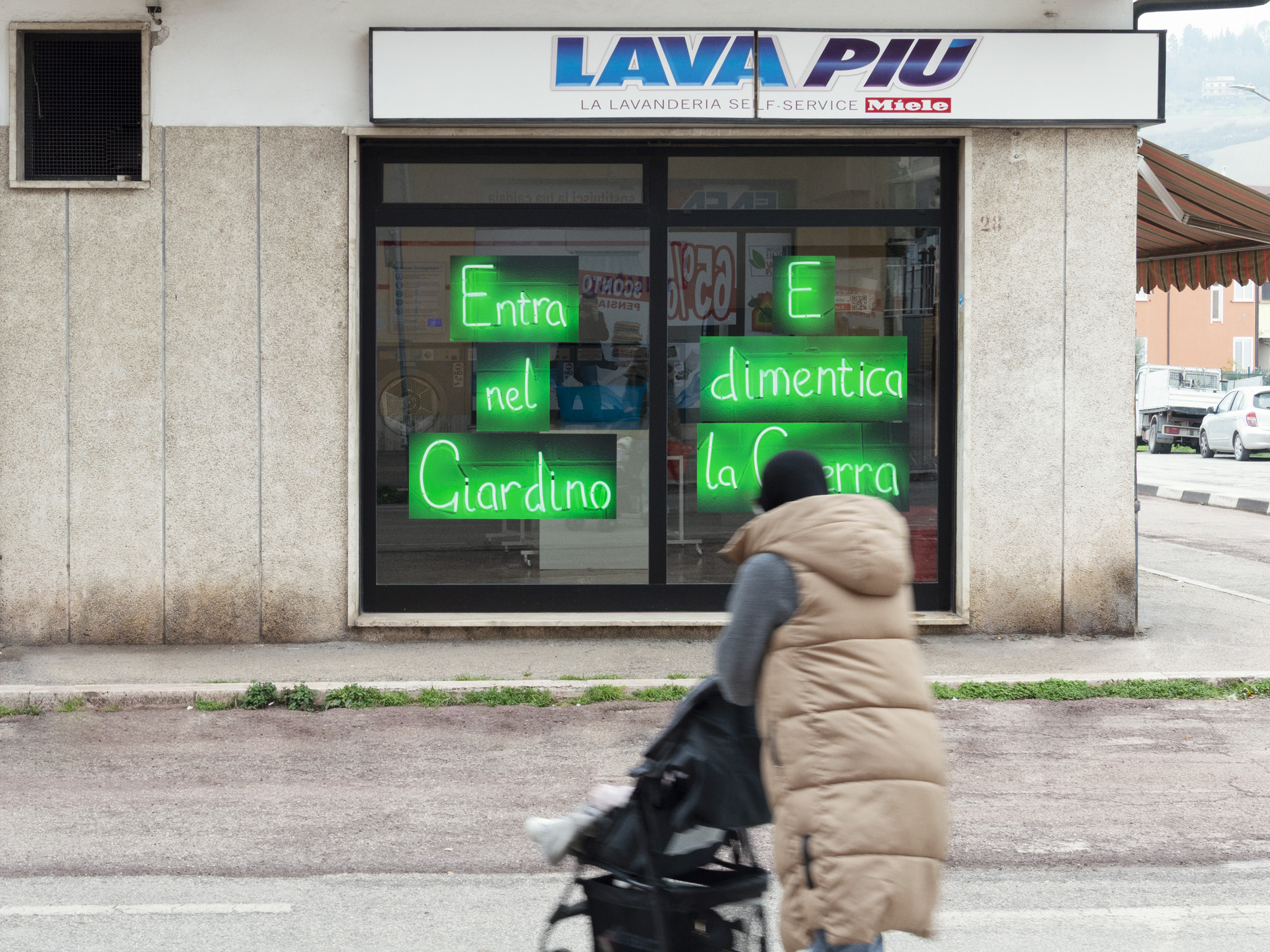
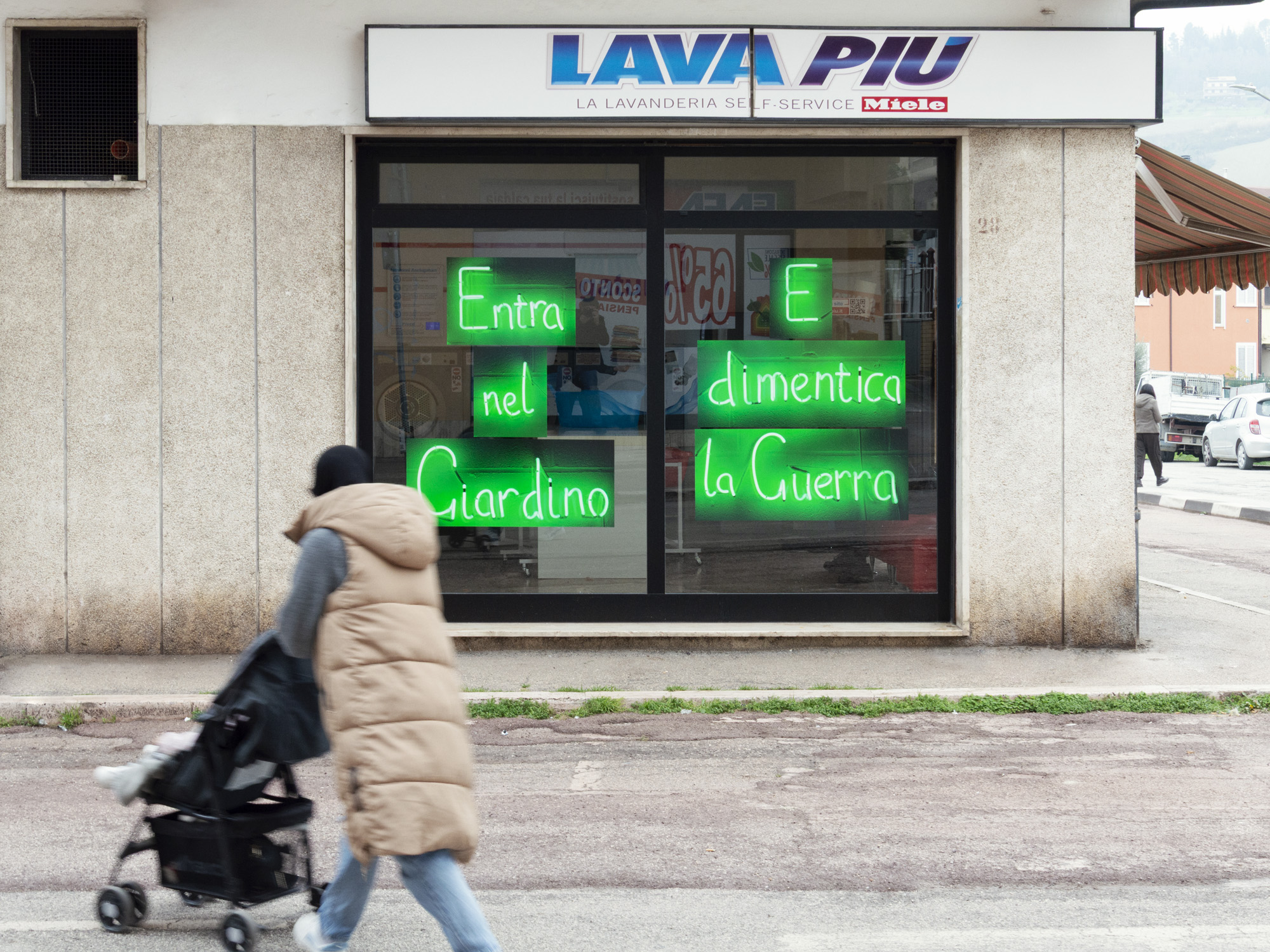
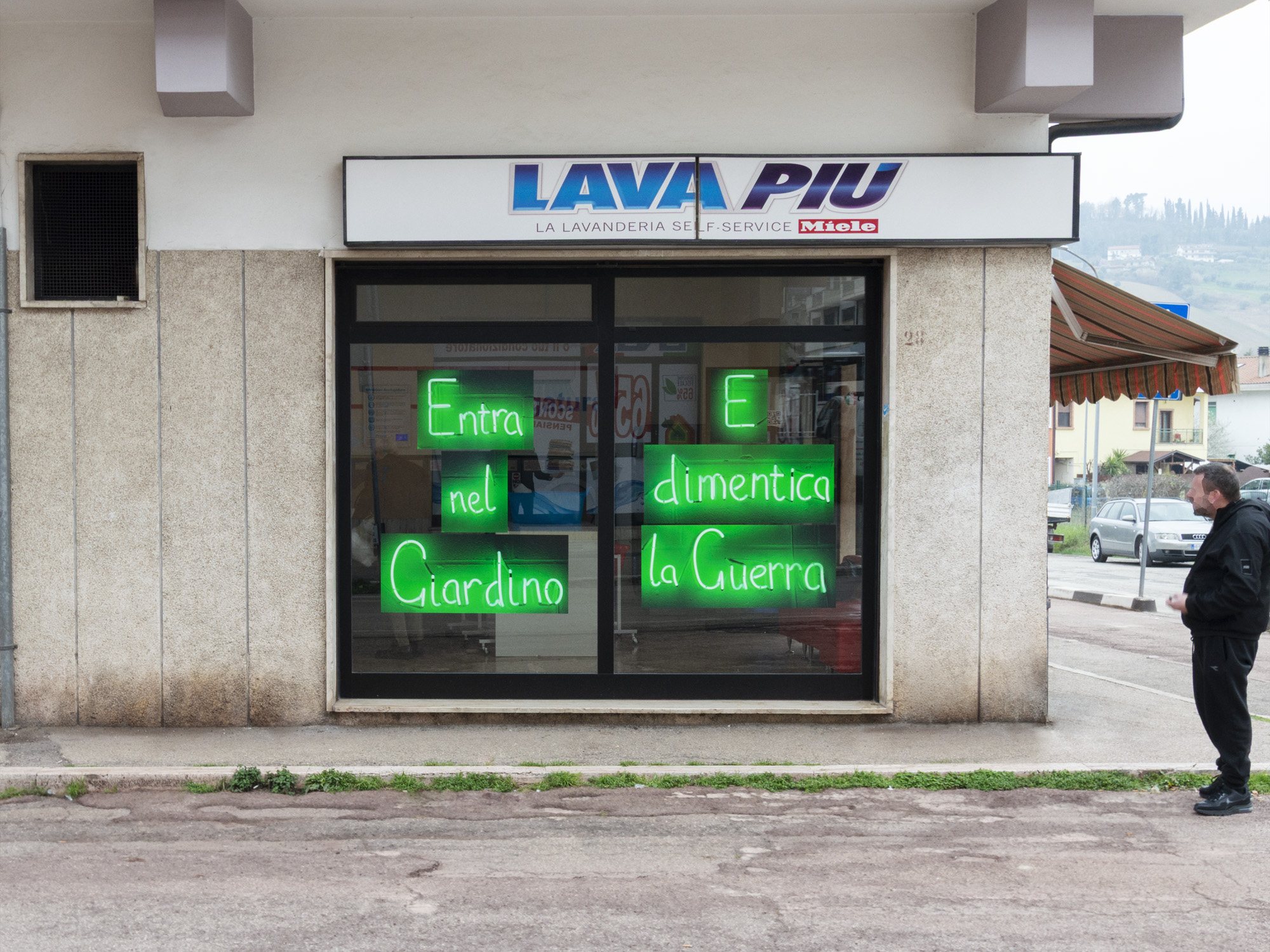
Exhibitionism Exhibitionism_From Saturday 7th March 2026, the work titled War/Garden (After Tubby) by Graham Fagen (Scotland, 1966) will be visible on the external shopfronts of the LAVAPIU laundrette in the Gammarana neighbourhood of Teramo. It is a photographic reproduction of a piece exhibited during the 2015 Venice Biennale, in which Graham represented the Scottish pavilion.
War/Garden (After Tubby) addresses one of the recurring themes in Graham Fagen’s research: war. The work originated from the artist’s stay at Talbot House in Poperinge, Belgium. Now a museum, this place played an extremely significant role during the First World War. Founded by two British Army chaplains to offer comfort to passing Allied soldiers engaged at the front, Talbot House was a combination between a gentlemen’s club and a rectory: a social experiment described as an oasis of serenity in a world gone mad.
In 2007, while working on another piece, Fagen was struck by a series of signs posted inside the house as a reminder to the military. One of them read: “Enter the garden and forget the war.” A few years later, the artist decided to reappropriate that message, translating it into a neon sign, crafted in his own handwriting.
The garden, a sort of neutral zone just a few kilometres from the front, is no longer merely a refuge from the First World War but becomes a metaphorical space in contemporary Europe. The work is conceived to be rendered in different languages and presented each time in different contexts.
Just over twenty years after the wars in the Balkans, the current geopolitical scenario sees the return of armed conflict within European borders. Rearmament policies are now a concrete, almost normalised reality, even in Italy, supported indiscriminately by the right and by part of the liberal left. An insidious propaganda, in fact, is trying to gain ground even in public schools. In light of this disconcerting horizon, Fagen’s work is placed within the context of LAVAPIU. And, transported into yet another context, the message bends: it is no longer so much an invitation to find shelter in a safe space (which Garden?) and leave the horror outside the door. Rather, it generates the opposite effect: the evocation, at the very moment it is named, of the same image that the words would prescribe us to forget. A possibility – the War – that the West deluded itself into believing concerned other geographies; domesticated in the stories of survivors, pacified by wreaths of flowers, engraved on tombstones or fused into stumbling stones.
War/Garden (After Tubby) configures itself as an interference into the collective torpor: it uses a visual language akin to commercial advertising (the neon light, here reproduced on a vinyl print) to generate a short-circuit that propagates in multiple trajectories. It is up to us, once again, to decide which ones.